Europe Packing lists
Europe packing list: ten days, lighter transfers
A Europe packing list is most useful when it follows the route: the weather at each stop, how often you change accommodation and what you need to carry between stations and rooms. This ten-day example focuses on city stays and train journeys, with one laundry stop and adjustments for warmer days, rain and colder conditions.

Photo: Mikheil Kuzmidi · Unsplash License · Cropped for layout.
- Example trip
- 10 days · city stays
- Laundry
- After day 5
- Travel style
- Trains + optional flights
- Adapt for
- Each stop’s weather + activities
In this guide
The short version
Pack ten days around five days of clothing and a laundry stop
For one adult on a mild-weather city trip, start with five tops, three bottoms, six sets of underwear, socks as needed, sleepwear, a mid-layer and forecast-appropriate outerwear, counting the travel outfit. Plan laundry after day 5. Add comfortable footwear, personal care, documents and compatible charging equipment, then check the packed bag against every train and flight.
Read the route before choosing the suitcase
List the overnight stops, travel days and booked activities. Note where you will have laundry and whether the accommodation supplies towels, a hairdryer or other bulky items you normally pack. Check access to the actual property, including steps, lifts and any walk from the nearest stop.
A bag that rolls comfortably through an airport may feel different on a station transfer or uneven pavement. Test the packed bag in the way you will use it. If stairs or lifting are difficult for you, confirm accessible routes and assistance with the relevant providers before choosing the journey.
Swipe or scroll to see all columns.
| Detail | What to check | Packing decision |
|---|---|---|
| Frequent accommodation changes | Storage, arrival time and access to rooms | Use a repeatable bag arrangement and keep the next arrival’s essentials accessible. |
| A dependable laundry stop | Opening, capacity, drying and turnaround time | Pack a smaller clothing cycle only when the wash fits the itinerary. |
| An internal flight | Your fare and every operating carrier’s allowance | Measure and weigh the bag; train allowance does not transfer to a flight. |
| A special activity | Venue rules, terrain, equipment and forecast | Add the specific kit or revise the activity, rather than packing for every possibility. |
For a route still taking shape, start with the Lisbon–Porto itinerary or the Paris–Lyon–Nice train itinerary. Use the places and travel days you actually choose to edit this list.
Use one clothing cycle, with a little reserve
The quantities below suit a mild-weather city trip with laundry after day 5 and comfortable rewearing of bottoms. They include what you wear on the journey. If you need a fresh top after a long walking day, add it deliberately or arrange another wash.
Swipe or scroll to see all columns.
| Item | Starting quantity | Practical adjustment |
|---|---|---|
| Tops | 5 total: wear 1, pack 4 | Wash after day 5; add a reserve if the laundry timing is uncertain. |
| Bottoms | 3 total: wear 1, pack 2 | Choose pieces that combine with several tops and can be reworn. |
| Underwear | 6 sets total: wear 1, pack 5 | Five daily sets plus a reserve; include your usual bras if worn. |
| Socks | 6 pairs total if worn daily | Match footwear, activity and your normal change routine. |
| Sleepwear | 1 set | Choose the amount that suits your comfort and washing preferences. |
| Mid-layer | 1 | Add warmth appropriate to your stops, especially cooler evenings. |
| Outerwear | 1 suitable piece for the forecast | Rain protection and winter insulation are different decisions. |
| Footwear | 1 comfortable main pair | Add a second pair for a real activity, drying backup or personal need. |
Choose combinations you are happy to repeat. A smarter top that works with your ordinary trousers can cover an evening booking without a separate outfit bag. Check dress requirements directly with any venue, including places of worship; one country or city does not have a single universal dress rule.
For a shorter trip, use the weekend quantities. For a focused destination adjustment, the Italy packing guide covers its own ten-day example.
Adjust for the stops, not a single European season
Check the forecast for each overnight base and any excursion. A coastal city, an inland stop and a mountain outing can need different clothing during the same week. Pack for the coldest and wettest parts you will actually encounter, rather than an average for the whole continent.
Swipe or scroll to see all columns.
| Conditions | Review | Avoid bringing automatically |
|---|---|---|
| Warm city days | Breathable clothing, comfortable walking shoes and suitable sun protection | Several duplicate outfits for unplanned evenings. |
| Changeable or wet days | Useful layers, appropriate outer protection and a way to separate damp items | An umbrella as the only solution for every activity or wind condition. |
| Cold city stays | Insulation, accessories and footwear suited to the actual forecast | A mild-weather list with one thin layer added. |
| Mountain or outdoor excursions | The operator’s or local authority’s current activity guidance and required equipment | The assumption that a city wardrobe is a hiking or snow kit. |
The winter packing list is a better starting point for a cold city break. For a Swiss route, use the Lucerne–Interlaken itinerary to identify the days that may need a weather alternative.
Keep a dry change and essential personal items where you can find them at the next accommodation. If clothes are still damp when you move on, separate them for transport and give them space to dry at the next suitable stop.
Check the bag for each train and flight
Check the railway operator’s rules for the specific service. Bag count, dimensions, special-item arrangements and storage vary. As one example, Eurostar requires travelers to be able to carry and store their own luggage, and its size rules depend on the route. That is a useful reason to test the bag, not a rule for every European train.
Keep tickets, identification required for the journey, phone and valuables in an accessible small compartment. Read your operator’s boarding and ticket instructions. Keep bags out of aisles and doorways and use the available storage as instructed; a large allowance does not guarantee a rack beside your seat.
If the route includes a flight, do a separate check of bag count, dimensions and weight for your fare. Your Europe’s luggage guidance distinguishes airline cabin allowances from airport security restrictions. Read the current airport instructions for liquids and prohibited items on every flight, including the journey home.
Keep the daily bag light and the charging kit compatible
Pack the day bag for the day’s plans: personal essentials, the required ticket, a useful layer and suitable water-carrying arrangements. Check venue bag policies before leaving your accommodation. You do not need every charger, spare outfit and guidebook with you on every short city walk.
Use a compact wash kit based on your ordinary routine, plus personal medicines, glasses and other care items. Confirm supplies from the accommodation rather than assuming they will be available. If you are arriving from abroad, check any restrictions on personal medicines with the relevant authorities.
Check sockets and device input ratings for every country on the route. Electrical Safety First’s adaptor guidance explains that plug adaptors do not change voltage or frequency. A product sold as a “Europe adaptor” may not suit every stop or device; check its actual compatibility, power rating and earthing requirements.
Bring the cables you need and test the combination at home. For a power bank, follow the airline’s current battery rules if flying. Keep booking information available without depending entirely on mobile data, and confirm your communication arrangement with your provider.
Do a station-to-room packing test
Close the bag with everything inside, including the wash kit and charging equipment. Check its size and weight, then try handling it as you will on the route. Leave room to repack after screening and to bring home the ordinary small things you collect during a trip.
Make the first evening’s clothes and personal essentials easy to find. If you change bases several times, return items to the same places each morning: wash kit, clothing, charging pouch and documents. A predictable arrangement is more useful than completely reorganizing the suitcase at every stop.
For friends traveling together, assign only the supplies you have agreed to share. Everyone still needs their own documents, care items and suitable clothing. The shared packing checklist helps make those responsibilities visible.
Try the packing list generator for a personal starting list, then add your route’s transport, laundry and weather decisions. For the wider airport and document plan, use the international travel packing list.
From reading to ready
Let the route shape your packing list
Keep your packing checklist, travel days and reservation notes together in Oreviyo. For shared supplies, assign a person to bring each item so the group can see what is covered.
Explore packing lists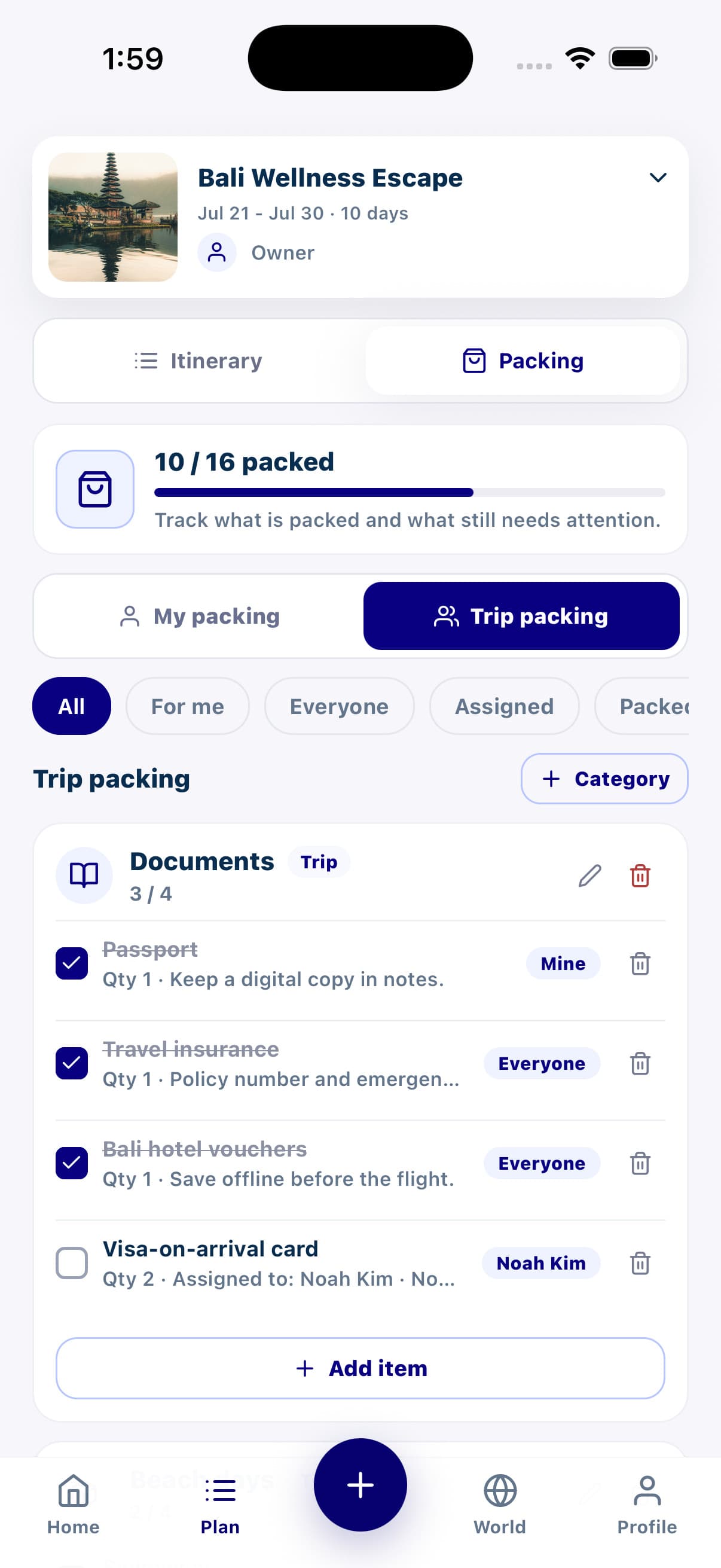
Common questions
What should I pack for ten days in Europe?
Can I use one carry-on for several European countries?
Is there one luggage allowance for European trains?
Will one travel adaptor work everywhere in Europe?
Does this list cover winter or a mountain trip?
Sources and useful links
Researched by Oreviyo using the sources below, reviewed on November 9, 2026. The routes, quantities, and packing examples are our suggestions. Confirm current conditions, access, and booking details before you go.
- Route-specific luggage allowances and carrying your bagsEurostar
- Airline baggage and airport security restrictionsEuropean Union — Your Europe
- Travel adaptor compatibility and safetyElectrical Safety First